
Search
conference
06.10.25 08.10.25

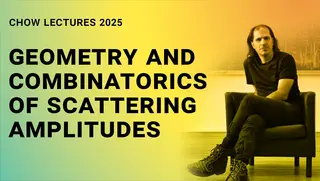
Chow Lectures 2025 by Nima Arkani-Hamed

Geometry and Combinatorics of Scattering Amplitudes

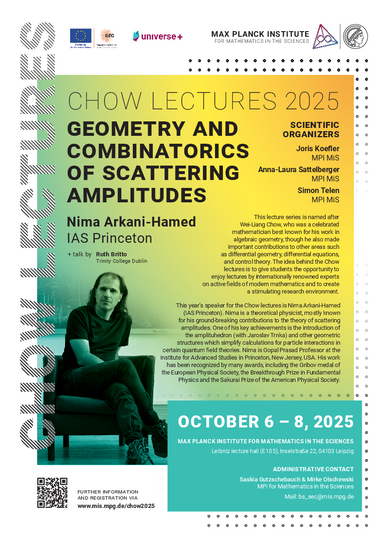
This year's speaker for the Chow lectures is Nima Arkani-Hamed (IAS Princeton). Nima Arkani-Hamed is a theoretical physicist, mostly known for his groundbreaking contributions to the theory of scattering amplitudes. One of his key achievements is the introduction of the amplituhedron (with Jaroslav Trnka) and other geometric structures which simplify calculations for particle interactions in certain quantum field theories. Nima is Gopal Prasad Professor at the Institute for Advanced Studies in Princeton, New Jersey, USA. His work has been recognized by many awards, including the Gribov medal of the European Physical Society (2003), the Breakthrough Prize in Fundamental Physics (2012) and the Sakurai Prize of the American Physical Society (2021).

This lecture series is named after Wei-Liang Chow (October 1, 1911, Shanghai – August 10, 1995, Baltimore), who was a celebrated mathematician best known for his work in algebraic geometry, though he also made important contributions to other areas such as differential geometry, differential equations, and control theory. Within algebraic geometry he is known among other things for his work on intersection theory (Chow's moving lemma, Chow ring), for Chow's theorem on algebraicity of projective analytic varieties, and for many other achievements.

Chow was born in Shanghai, had his school education in the United States, and graduated from the University of Chicago in 1931. He obtained his PhD in Leipzig in 1936, where he worked with van der Waerden (who was a professor at the University of Leipzig), introducing in particular Chow coordinates. Subsequently, Chow was a professor in Nanjing, Princeton and at Johns Hopkins University were he worked until 1977.

The idea behind the Chow lectures is to give students the opportunity to enjoy lectures by internationally renowned experts on active fields of modern mathematics and to create a stimulating research environment.

WARNING: Please be wary if a company directly contacts you regarding payment for accommodation in Leipzig: this is fraud / phishing. The communication and organisation of this school is carried out exclusively by staff of the MPI MiS.

This activity is financially supported by the ERC Synergy Grant UNIVERSE+ www.positive-geometry.com, funded by the European Union (ERC, UNIVERSE PLUS, 101118787). Views and opinions expressed are however those of the author(s) only and do not necessarily reflect those of the European Union or the European Research Council Executive Agency. Neither the European Union nor the granting authority can be held responsible for them.

logo universe+

Please see also the poster overview at Poster Session

Speakers

Nima Arkani-Hamed

IAS Princeton

Ruth Britto

Trinity College Dublin

Carolina Figueiredo

IAS Princeton

Elia Mazzucchelli

Max Planck Institut fur Physik, München

Francesca Zaffalon

Max Planck Institute for Mathematics in the Sciences, Leipzig

Program

09:30 - 10:00
10:00 - 11:00
11:00 - 11:30
11:30 - 12:30
12:30 - 14:00
14:00 - 16:00
16:00 - 16:30
16:30 - 18:00
Poster Session
10:00 - 11:00
11:00 - 11:30
11:30 - 12:30
12:30 - 14:00
14:00 - 15:00 Ruth Britto (Trinity College Dublin)
Coaction on Feynman diagrams, Feynman integrals, and hypergeometric functions
15:00 - 15:30
15:30 - 17:30
18:30 - 22:00

Participants

Nima Arkani-Hamed

IAS Princeton

George Balla

MPI MiS Leipzig

Daniel Baumann

University of Amsterdam

Barbara Betti

Max Planck Institute for Mathematics in the Sciences

Irina Bobrova

MPI MiS

Viktoriia Borovik

MPI MiS Leipzig

Ruth Britto

Trinity College Dublin

Veronica Calvo Cortes

MPI MiS Leipzig

Victor Carmona

MPI MiS

Sérgio Carrôlo

Max Planck Institute for Physics

Türkü Özlüm Çelik

MPI CBG Dresden

Chandramouli Chowdhury

University of Southampton

Emiel Claasen

Max Planck Institute for Gravitational Physics

Shelby Cox

MPI MiS

Claire de Korte

Max Planck Institute for Mathematics in the Sciences

Jin Dong

Max Planck Institute for Physics

Nicholas Early

IAS Princeton

Marcel Eichberg

University of Paderborn

Angelo El Saliby

Max Plank Institute for Mathematics in the Sciences

Guilherme Feitosa de Almeida

MPI CBG Dresden

Kamillo Ferry

TU Berlin

Claudia Fevola

Inria Saclay

Carolina Figueiredo

IAS Princeton

Mieke Fink

University Osnabrück

Alheydis Geiger

MPI MiS

Bruno Gimenez Umbert

University of Southampton

Maximilian Göbel

TU Chemnitz

Paul Görlach

Otto von Guericke University of Magdeburg

Kurt Klement Gottwald

TU Chemnitz

Moritz Grillo

MPI MiS

Edgar Harutyunyan

Universität Leipzig

Subramanya Hegde

Max Planck Institute for Physics Munich

Johannes Henn

Max Planck Institute for Physics

Adolfo Hilario-Garcia

Max Planck Institute for Physics

Christoph Hinkel

Leipzig University

Benjamin Hollering

Max Planck Institute for Mathematics in the Sciences

Rutvirsinh Jadeja

Leipzig University

Nihal Jalal Pullisseri

Universität Lepzig

Leonie Kayser

MPI MiS

Elizabeth Kelauridze

University of Bonn

Xavier Kervyn

Max Planck Institute for Physics

Joris Köfler

Max Planck Institute for Mathematics in the Sciences

Mylana Krasnobaieva

Leipzig University

Daria Kriuchkova

Moscow Institute of Physics and Technology (MIPT)

Arne Kuhrs

Paderborn University

Yining Lan

University of Bonn

Enoch Leung

MPI MiS

Emiliano Liwski

KU Leuven

Felix Lotter

MPI MiS Leipzig

Julien Martin

Leipzig University

Saiei-Jaeyeong Matsubara-Heo

Tohoku University

Elia Mazzucchelli

Max Planck Institut fur Physik

Elene Meskhi

Universität Bonn

Eckehard Olbrich

Max Planck Institute for Mathematics in the Sciences

Matteo Parisi

MPI MPP München

Gianni Petrella

University of Luxembourg

Anaëlle Pfister

Max Planck Institute for Mathematics in the Sciences

Nathan Pflueger

Amherst College / MPI MiS

Eric Pichon-Pharabod

MPI MiS

Paula Naomi Pilatus

University of Hamburg

Andrzej Pokraka

University of Amsterdam

Irem Portakal

MPI MiS

Armin Pournaki

MPI MiS

David Prinz

Max Planck Institute for Mathematics, Bonn

Prashanth Raman

Max Planck Institute for physics

Vincenzo Reda

Trinity College Dublin

Matthew Rochford

University of Southampton

Carlos Rodriguez

Max Planck Institute for Mathematics in the Sciences

Andrea Rosana

MPI MiS

Anna-Laura Sattelberger

Max Planck Institute for Mathematics in the Sciences

Otto T.P. Schmidt

MPI MiS Leipzig

Georgy Scholten

MPI-CBG

Sebastian Seemann

KU Leuven

Cathrin Semper

University Bonn

Kakha Shamanauri

University of Bonn

Rainer Sinn

Universität Leipzig

Luca Sodomaco

MPI MiS

Pedro Souza

Goethe-Universität Frankfurt am Main

Peter Spacek

TU Chemnitz

Jonah Stalknecht

Charles University

Bernd Sturmfels

MPI MiS, Leipzig

David Suero Casado

TU Chemnitz

Máté Telek

MPI MiS, Leipzig

Simon Telen

Max Planck Institute for Mathematics in the Sciences

Hannah Tillmann-Morris

King’s College London

Julian Weigert

MPI MiS/University Leipzig

Nicolas Alexander Weiss

MPI MiS

Maximilian Wiesmann

CSBD Dresden

Martin Winter

TU Berlin / MPI Leipzig

Qinglin Yang

Max Planck Institute for Physics

Teresa Yu

MPI MiS

Bailee Zacovic

University of Michigan

Francesca Zaffalon

Max Planck Institute for Mathematics in the Sciences

Organizers

Joris Köfler

Max Planck Institute for Mathematics in the Sciences

Anna-Laura Sattelberger

Max Planck Institute for Mathematics in the Sciences

Simon Telen

Max Planck Institute for Mathematics in the Sciences

Administrative Contact

Saskia Gutzschebauch

Max Planck Institute for Mathematics in the Sciences Contact via Mail

Mirke Olschewski

Max Planck Institute for Mathematics in the Sciences Contact via Mail