Search
Workshop on Geometry, Topology and Machine Learning
conference
10.11.25 14.11.25

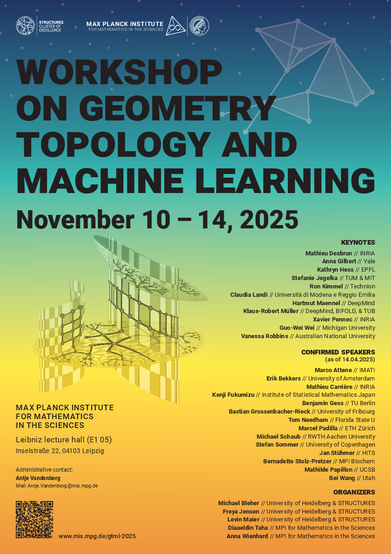
Workshop on Geometry, Topology, and Machine Learning (GTML 2025)

Registration is now closed.


The Geometry and Topology in Machine Learning (GTML) workshop brings together two rapidly evolving fields central to modern machine learning. Geometry and topology provide essential methods for describing data structure and frameworks for analyzing, unifying, and generalizing machine learning techniques to new settings.

The workshop will feature 10 keynote talks and 20 presentations by leading experts. By merging the Workshop on Geometry in Machine Learning (GaML) and the Workshop on Topological Methods in Data Analysis (TMDA), GTML creates a platform to foster collaboration and explore the interplay between geometry, topology, and machine learning.

GTML 2025 is organized jointly by the Max Planck Institute for Mathematics in the Sciences and the STRUCTURES Cluster of Excellence.

Focus:

Topics of interest include, but are not limited to, the following:

  • Mathematical foundations of machine learning
  • Geometric machine learning (e.g., geometric deep learning, graph neural networks, geometry processing)
  • Topological machine learning (e.g., topological deep learning, topological data analysis (TDA), shape analysis)
  • Applications of geometry and topology in machine learning (e.g., in life sciences and complex systems)

Sessions:

  • Foundations of Machine Learning I and II
  • Geometric Deep Learning
  • Geometry Processing/Geometric Data Analysis
  • Geometric Statistics
  • Shape Analysis
  • Topological Deep Learning
  • Topological Data Analysis I, II, and III

Confirmed Speakers:

  • Keynotes:
    • Mathieu Desbrun (INRIA)
    • Anna Gilbert (Yale)
    • Kathryn Hess (EPFL)
    • Stefanie Jegelka (TUM & MIT)
    • Ron Kimmel (Technion)
    • Claudia Landi (University of Modena and Reggio Emilia)
    • Hartmut Maennel (DeepMind)
    • Xavier Pennec (INRIA)
    • Vanessa Robbins (Australian National University)
    • Guo-Wei Wei (MSU)
  • Talks:
    • Oleg Arenz (TU Darmstadt)
    • Marco Attene (IMATI)
    • Erik Bekkers (University of Amsterdam)
    • Mathieu Carrière (INRIA)
    • Kenji Fukumizu (Institute of Statistical Mathematics Japan)
    • Banjamin Gess (TU Berlin)
    • Bastian Grossenbacher-Rieck (University of Fribourg)
    • Mustafa Hajij (USFCA)
    • Søren Hauberg (TU Denmark)
    • Robert Lilow (Deepshore)
    • Guido Montúfar (MPI MiS, UCLA)
    • Tom Needham (Florida State University)
    • Mathilde Papillon (UC Santa Barbara)
    • Bei Wang Philips (Utah)
    • Michael Schaub (RWTH Aachen University)
    • Stefan Sommer (University of Copenhagen)
    • Vincent Stimper (Isomorphic Labs)
    • Jan Stühmer (HITS)
    • Bernadette Stolz-Pretzer (MPI for Biochemistry)
    • Alice Barbora Tumpach (Wolfgang Pauli Institute)
    • François-Xavier Vialard (Université Gustav Eiffel)

Deadline:

    You can apply to present a lightning talk. See the registration page for more information. The application deadline is May 31, 2025.

WARNING: Please be wary if a company directly contacts you regarding payment for accommodation in Leipzig: this is fraud / phishing.

Previous Workshops:

Program

08:30 - 08:55
08:55 - 09:00
09:00 - 10:00
10:00 - 10:30
10:30 - 11:00 Guido Montufar
Constraining the outputs of ReLU neural networks
11:00 - 11:30 Benjamin Gess
Effective fluctuating continuum models for Riemannian SGD
11:30 - 12:00
12:00 - 14:00
14:00 - 15:00
15:00 - 15:30
15:30 - 16:00 François-Xavier Vialard
Training of deep ResNets and shallow networks in the lense of optimal transport
16:00 - 16:30 Alice Barbora Tumpach
Infinite-dimensional Geometry and Artificial Intelligence
16:30 - 17:00
16:30 - 20:00
08:45 - 09:00
09:00 - 10:00 Guowei Wei
Topological data analysis and topological deep learning beyond persistent homology
10:00 - 10:30
10:30 - 11:00 Bastian Grossenbacher-Rieck
Shapes, Spaces, Simplices, and Structure: Geometry, Topology, and Machine Learning
11:00 - 11:30 Mustafa Hajij
Copresheaf Topological Neural Networks: A Generalized Deep Learning Framework
11:30 - 12:00
12:10 - 14:00
14:00 - 15:00 Hartmut Maennel
Complete and Efficient Covariants for 3D Point Configurations with Application to Learning Molecular Quantum Properties
15:00 - 15:30
15:30 - 16:00 Robert Lilow
Optimizing Distributed Data Processing with Reinforcement Learning
16:00 - 16:30 Jan Stühmer
Equivariance as Design Principle for Modern Deep Learning
16:30 - 17:00
17:00 - 18:00
08:45 - 09:00
09:00 - 10:00 Kathryn Hess Bellwald
Topological perspectives on the connectome
10:00 - 10:30
10:30 - 11:30 Vanessa Robins
The Extended Persistent Homology Transform for Manifolds with Boundary
11:30 - 11:45
11:45 - 12:15 Bei Wang Phillips
Charting LLM Embedding Spaces with Explainable Mapper
12:15 - 14:00
14:15 - 15:15 Ron Kimmel
On shape reconstruction & analysis via synthetic stereo, handling missing parts cuts and holes.
15:15 - 15:30
15:30 - 16:00 Tom Needham
Variants of Gromov-Wasserstein distances
16:00 - 16:30 Stefan Sommer
Score learning and inference for diffusion processes on shape spaces
19:00 - 22:00
08:45 - 09:00
09:00 - 10:00 Kenji Fukumizu
Neural Fourier Transform: a method of deep equivariant representation learning
10:00 - 10:30
10:30 - 11:00 Michael Schaub
Vectorial representations of topological features: a spectral perspective.
11:00 - 11:30 Mathilde Papillon
Make Any Graph Neural Network Go Topological with TopoTune
11:30 - 12:00
12:00 - 14:00
14:00 - 15:00 Mathieu Desbrun
Grooming with Cartan: vector field processing on triangle meshes
15:00 - 15:30
15:30 - 16:00 Søren Hauberg
Reparametrization invariance in Bayesian approximations
16:00 - 16:30 Marco ATTENE
Robust Geometry Processing
16:30 - 17:00
17:00 - 18:00
08:45 - 09:00
09:00 - 10:00 Xavier Pennec
Geometric statistics in computational anatomy: old & new
10:00 - 10:30
10:30 - 11:00 Erik Bekkers
Platonic Transformers: A Solid Choice for Equivariance
11:00 - 11:30
11:30 - 12:00
12:00 - 14:00
14:00 - 15:00 Claudia Landi
Theoretical Insights into Effective Resistance in Simplicial Complexes
15:00 - 15:30
15:30 - 16:00 Bernadette Stolz
Topological learning for spatial data in the life sciences
16:00 - 16:30 Mathieu Carrière
Differentiable and Measure-Based Mapper
16:30 - 16:40

Participants

Kossi Amouzouvi

ScaDS.AI@TU Dresden

Luter Caleb Aondona

University of L'Aquila

Oleg Arenz

TU Darmstadt

Georgios Arvanitidis

Technical University of Denmark

Marco ATTENE

IMATI-CNR

Yemeen Ayub

Michigan State University

Nazife Ayyildiz

MPI for Human Cognitive and Brain Sciences

Irina Barnaveli

Max Planck Institute for Human Cognitive and Brain Sciences

Erik Bekkers

University of Amsterdam

Matteo Biagetti

Area Science Park

Michael Bleher

University of Heidelberg & STRUCTURES

Yossi Bokor Bleile

Institute of Science and Technology Austria

Mathieu Carrière

Centre Inria d'Université Côte d'Azur

Lorenzo Cazzella

Politecnico di Milano

Marek Cerny

University of Antwerp

Madhav Cherupilil Sajeev

Institute Polytechnique de Paris

Hana Dal Poz Kourimska

University of Potsdam

Cong Thanh Dang

Technical University of Munich

Anupam Datta

University of Bonn

Mathieu Desbrun

Inria / Ecole Polytechnique

Leon Duensing

ScaDs.AI

Marzieh Eidi

Max Planck/ Scads. AI

Naima Elosegui Borras

DTU Compute

Sylvain Estebe

Aarhus University

Kenji Fukumizu

Institute of Statistical Mathematics

Daniel Gallagher

University Leipzig

Yuri Gardinazzi

University of Trieste - Area Science Park, Trieste

Anna Dragana Gaugler

Uni Bonn

Johanna Marie Gegenfurtner

Technical University of Denmark

Jan Gerken

Chalmers Institute of Technology

Benjamin Gess

TU Berlin & MPI MiS Leipzig

Anna Gilbert

Yale University

Susan Glenn

Los Alamos National Lab

Moritz Grillo

MPI MIS Leipzig

Bastian Grossenbacher-Rieck

University of Fribourg

Marco Guerra

IMATI Genoa - CNR

Loizos Hadjiloizou

KTH Royal Institute of Technology

Maximilian Hahn

Two Sigma

Mustafa Hajij

Vinci4d.ai, University of San Francisco

Abdul Halim

Georg August University of Göttingen

Michael Hanna

Max Planck Institute of Molecular Cell Biology and Genetics

Baran Hashemi

ODSL

Søren Hauberg

Technical University of Denmark

Moritz Hehl

Leipzig University

Kathryn Hess Bellwald

EPFL

Nicolás Hinrichs

Okinawa Institute of Science & Technology, Max Planck Institute for Human Cognitive and Brain Sciences

Jan-Philipp Hoffmann

Darmstadt University of Applied Science / European University of Technology

Yujia Hu

TU Dresden

Jacob Hume

University of Oxford

Daniel Ilkovic

University of Leipzig

Tom Jacobs

CISPA Helmholtz Center

Albert Kjøller Jacobsen

Technical University of Denmark

Noémie Jaquier

KTH Royal Institute of Technology

Stefanie Jegelka

TU Munich

Freya Jensen

University of Heidelberg & STRUCTURES

Hyeonhee Jin

Max Planck Institue for Mathematics

Parvaneh Joharinad

ScaDS.AI Dresden/Leipzig, MPI-MIS

Iolo Jones

Durham University

Harshit Juneja

Otto Von Guericke University Magdeburg

Sekou Oumar Kaba

McGill University

Ron Kimmel

CS Dept. Technion IIT

Maximilian Krahn

Aalto University

Daniel Kral

Leipzig University and MPI-MiS

Deniz Kucukahmetler

Max Planck Institute for Human Cognitive and Brain Sciences, SECAI: School of Embedded Composite Artificial Intelligence

Fangfei Lan

University of Lausanne

Fabian Lander

MPI MIS

Claudia Landi

University of Modena and Reggio Emilia

Kang-Ju Lee

Seoul National University

Kathryn Lesh

Union College, MIT

Kolya Lettl

Leipzig University

Robert Lilow

Deepshore

David Loiseaux

Inria Saclay

Hartmut Maennel

Google DeepMind Zürich

Kelly Maggs

Max Planck Insitute for Cell Biology and Genetics

Levin Maier

University of Heidelberg & STRUCTURES

Meent Mangels

MPI CBS

Krishna Sri Ipsit Mantri

University of Bonn, Lamarr Institute

Rostislav Matveev

None

Stephan Meyer

Max Planck Institute for Human Cognitive and Brain Sciences

Nikola Milosevic

Max Planck Institute for Hunan Cognitive and Brain Sciences

Guido Montufar

UCLA / MPI MiS

Francesco Morabito

ETH Zürich

Agustin Moreno

Heidelberg University

Tom Needham

Florida State University

Maximilian Neumann

KIT

Wayne Ng Kwing King

Universidad de Zaragoza & Université de Pau et des Pays de l'Adour

Merik Niemeyer

MPI MiS

Elias Nyholm

Chalmers University of Technology

Eckehard Olbrich

Max Planck Institute for Mathematics in the Sciences

Andreas Ott

Heidelberg University

Susovan PAL

Vrije Universiteit Brüssel (Free University of Brussels)

Mathilde Papillon

University of California Santa Barbara

Prayagdeep Parija

Virginia Tech

Matteo Pegoraro

KTH

Xavier Pennec

Université Côte d'Azur and INRIA, France

Bei Wang Phillips

University of Utah

Shrunal Pothagoni

George Mason University

Zhan Qu

TU Dresden/ScaDS.AI

Vanessa Robins

The Australian National University

Daniel Roggenkamp

MPI MiS

Philip Rolles

Heidelberg University, STRUCTURES, Centrale Institute for Mental Health Mannheim

Sophie Rosenmeier

MPI for Biochemistry

Armand Rousselot

Heidelberg university

Celia Rubio Madrigal

CISPA Helmholtz Center

Francesco Ruscelli

Universität Heidelberg

Nikola Sadovek

MPI CBG Dresden

Hannah Santa Cruz Baur

VU Amsterdam

Michael Schaub

RWTH Aachen University

Nico Scherf

Max Planck Institute for Human Cognitive and Brain Sciences, Leipzig

Leonard Schmitz

TU Berlin

Krrish Seth

Michigan State University, Wei labs

Ankita Shukla

University of Nevada, Reno

Aislinn Smith

The University of Texas at Austin

Sasha Smolarchik Brenner Socas

Max Planck Institute for Human Cognitive and Brain Sciences, Leipzig University

Stefan Sommer

University of Copenhagen

Hae Jin Song

University of Southern California (USC)

Vincent Stimper

Isomorphic Labs

Bernadette Stolz

Max Planck Institute of Biochemistry

Jan Stühmer

Heidelberg Institute for Theoretical Studies

Bernd Sturmfels

MPI MiS

Stas Syrota

TU Denmark

Diaaeldin Taha

Max Planck Institute for Mathematics in the Sciences

Immanuel Thoke

ScaDS.AI / University Leipzig

Yu Tian

Center for Systems Biology Dresden, MPI CBG | PKS

Nahid Torbati

Max Planck CBS

Alice Barbora Tumpach

Wolfgang Pauli Institut

François-Xavier Vialard

Univ. Gustave Eiffel

Anna Wienhard

Max Planck Institute for Mathematics in the Sciences

Adam Zheleznyak

University of California, Los Angeles

Jing Zou

TU Dresden

Organizers

Michael Bleher

University of Heidelberg & STRUCTURES

Freya Jensen

University of Heidelberg & STRUCTURES

Levin Maier

University of Heidelberg & STRUCTURES

Diaaeldin Taha

Max Planck Institute for Mathematics in the Sciences

Anna Wienhard

Max Planck Institute for Mathematics in the Sciences

Administrative Contact

Antje Vandenberg

Max Planck Institute for Mathematics in the Sciences Contact via Mail